Pietro BENVENUTI
Portrait of Elisa Baciocchi, 1812 - 1814

Private collection, Paris
Paris, Salon 1810
The Strad, March 2024, pag. 46
Jacques Pierre Joseph Rode was born in Bordeaux on February 16, 1774. The son of a perfumer, he showed extraordinary musical talent from an early age to the point that he was sent to volino lessons by André-Joseph Fauvel. In 1787, when he was only 13 years old, he arrived in Paris where he became the principal pupil of Giovanni Battista Viotti, the most important violinist of the time and founder of the modern French violin school. Three years later he made his debut as soloist in Viotti’s Violin Concerto No. 13; he also joined the orchestra of the Théâtre de Monsieur, where he befriended fellow violinist Pierre Baillot.
His professional breakthrough came in 1792, when - on the occasion of the traditional Holy Week concerts - he performed six times between April 1 and April 13; these performances included two concertos by Viotti, one of which was a world premiere. For the next sixteen years Rode lived the life of an itinerant virtuoso, despite his appointment (1795) as a teacher at the violin department of the newly organized National Conservatory of Music and Dramatic Art in Paris. There he collaborated with Baillot and Kreutzer on a manual of instruction for the violin (Méthode de violon), published in 1803. During a tour of Spain in 1799 he met Luigi Boccherini, whose new orchestration of his Concerto No. 6 he performed. After a long concert tour he was appointed violin soloist of the musique particulière of the First Consul, Napoleon, and for a short time was also violin soloist of the Opéra. Between 1804 and 1808 he stayed in Russia, where he was appointed court violinist to Tsar Alexander I. After his return to Paris he began to travel around Europe. In Vienna, in late 1812, he performed with Archduke Rudolf, who accompanied him on the piano, in Beethoven's famous Violin Sonata Op. 96. Between 1814 and 1821 he was in Berlin, where he met and married his wife and became close friends with the Mendelssohn family. Here he composes his famous 24 caprices. In 1821 Rode returns to his native Bordeaux, where he now lives in semi-retirement. His last performance took place in Paris in the fall of 1828, but his unsuccessful performance embittered him, and his health suffered severely. Stricken by a stroke, he died in the Chàteau de Bourdon, near Damazan, on November 25, 1830.
His musical output, entirely dedicated to the violin, includes thirteen concertos and twenty-four caprices as well as sonatas and duets. His caprices, in particular, have assumed a permanent place in violin literature since they are preparatory to solid technical and musical training.
The shy character and frank attitude recalled by the sources emerge clearly in this splendid portrait executed during the first decade of the 19th century. The author is almost certainly the painter and miniaturist Jacques Antoine Marie Lemoine, author of portraits of the most famous personalities in the world of music and dance of the time. Indeed, among the works he exhibited at the Paris Salon of 1810 the catalogs include a Portrait de M. Rode, premier violon de l'empereur de Russie et ci-devant premier violon de Sa Majesté l'Empereur des Français, to be identified precisely with the one under consideration.
Lemoine depicts him skinny, dressed in an elegant suit of light jacket and dark pants, tie somewhat loose, hair slightly ruffled, left hand holding a violin, right hand flipping through the crumpled pages of a score, noble in bearing as in the pensiveness of his face, Rode here embodies the pre-Romantic artist, concentrated in the search for creative inspiration. All expressed in a soft, vibrant painting of Davidian ancestry, found in other works by the French artist, such as in Portrait d’une dame avec son fils et sa fille au balcon d’une fenêtre and that of M. Levasseur père, violoncelle de la musique particulière de l'Empereur, whose setting is close to that of Rode’s portrait.

Henri Grévedon (1776-1830)
Violinista francese Jacques Pierre Joseph Rode
Litografia, 1827
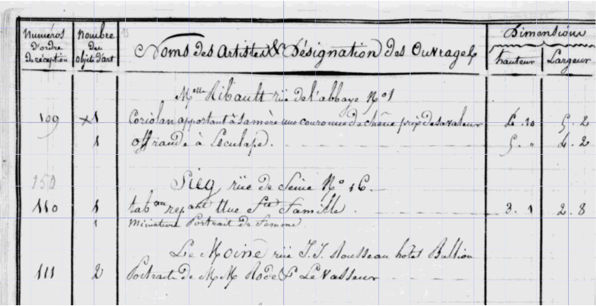
In 1810, the portrait painter Jacques-Antoine-Marie Lemoine (1751-1824) exhibited at the Paris Salon a portrait of the violinist Rode together with a second portrait of the well-known cellist Jean-Henri Levasseur, known as “the younger” (1764 - 1826).
Entered together with the portrait of the cellist Levasseur under no. 111 on the list of works submitted by Lemoine to be exhibited at the Salon, as “Le Moine rue J.J. Rousseau Hotel Ballion Ritratti di MM. Rode e Le Vasseur”, regrettably, whoever logged the entry did not indicate the measurements of the canvases; we therefore have no idea what size they were, whether they were small or large-format works as in the case of our painting.


Subscribe to our newsletter to receive all the news about exhibitions, fairs and new acquisitions!