Oskar BERGMAN Stockholm 1879 -Saltsjöbaden 1963
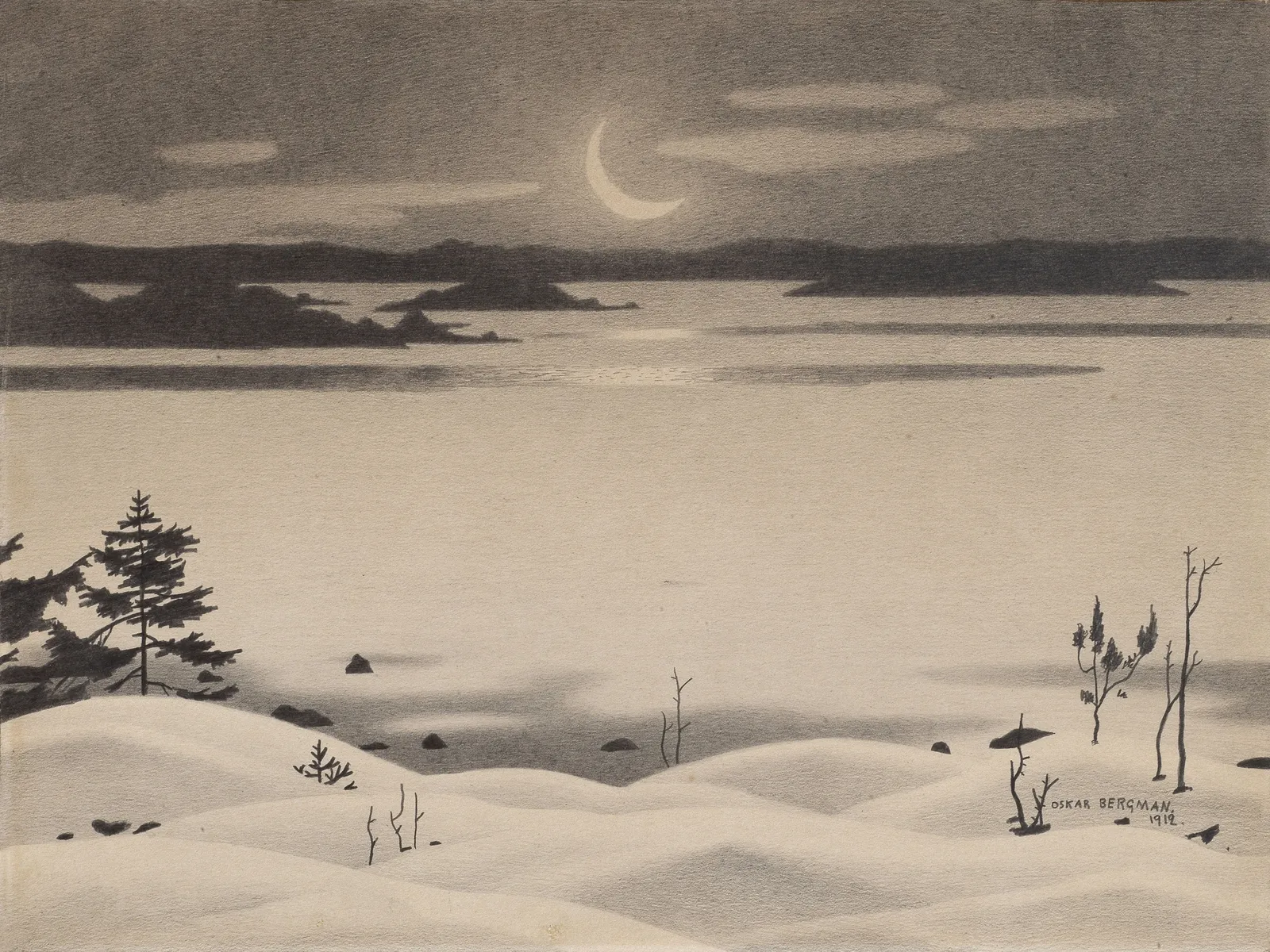
Snowy Landscape in Moonlight, 1912
Pencil on paper
23 x 31 cm
Signed and dated lower right: Oskar Bergman / 1912
Oskar Bergman was a fiercely independent landscape painter in 20th-century Swedish art, a virtuoso of watercolour and gouache, who chose fidelity to nature - and to a certain idea of slowness - at a time when the avant-garde was redefining the grammar of modernity.
Bergman trained outside the academic system from an early age. At the age of sixteen, he attended a technical school and received an education, but refused to follow the 'obligatory' path of the Academy; he preferred to invest his savings in study trips to European museums and collections. In Germany, he discovered Caspar David Friedrich, whose way of making the landscape 'breathe' - without emphasis, but with an inner intensity - left a lasting impression on him. Back in Sweden, a decisive milestone was reached with the banker and great collector Ernest Thiel, who encouraged him and introduced him to Saltsjöbaden, a resort and centre for artistic exchange. It was also through this network that Bergman met the French Symbolist painter Armand Point in 1904. Impressed by his drawings, Point invited him to come and work in Florence; Thiel financed the trip, which included stops in Berlin, Munich, Verona and Rome, and Point offered him 'hands-on' teaching based on the demands of drawing and the construction of forms. This Florentine episode did not lead Bergman towards spectacular allegory; rather, it armed him with a visual discipline that would give his drawings an almost miniaturist precision. The Swedish encyclopaedia highlights this vein of 'small' realistic compositions, detailed, with light and restrained colours, where human and animal figures are rare, as if the world could tell its story without narrative, through the eloquence of trees, roads, edges and waters alone.
At the turn of the 1900s-1910s, as the Swedish scene fractured (notably with the arrival of more expressionist languages), Bergman continued on his path: an art of the seasons and the meteorology of the soul, attentive to thresholds - melting snow, February light, northern twilights - where reality imperceptibly shifts towards the strange. A recent catalogue text emphasises this point: his watercolours, with their obvious realism, nevertheless retain a certain naivety and timelessness, as if they were deliberately keeping their distance from manifestos and schools. This consistency is not a sign of withdrawal. Bergman exhibited, travelled, and gained institutional recognition: in 1917, the Nationalmuseum in Stockholm acquired a watercolour (By the Sea), a sign of early legitimisation. In France, the Musée d'Orsay houses Flaques dans la neige (1904), a pivotal work in its ability to turn the humblest motif into a true painting event.
Settling permanently in Saltsjöbaden, near the Neglinge farm, Bergman remained faithful to his major subject: the Swedish landscape, envisaged as a silent theatre where the technique of watercolour - its transparencies, its reserves, its breaths - became an ethic of the gaze. Awarded the Egron Lundgren Medal in 1957 by King Gustaf VI Adolf, he died recognised as one of the great national landscape painters, precisely because he was able to capture, in the modest space of a sheet of paper, an entire experience of the world: clear, rigorous and secretly inhabited.
His art is marked by an intimate and meditative view of nature, far removed from both nineteenth-century descriptive naturalism and the more radical avant-garde movements. His graphic work—such as Snowy Landscape in the Moonlight (1912)—shows an extraordinary ability to suggest atmosphere and space through subtle tonal variations. At a time when painting dominated the art world, Bergman reaffirmed drawing as a fully developed and poetic medium.
The composition is structured in broad horizontal bands: the gently undulating foreground of snow, dotted with sparse bushes and slender tree trunks, leads to a still stretch of water reflecting the crescent moon. Beyond this, a dark line of islands and headlands marks the horizon beneath a veiled sky. The monochrome use of graphite enhances the essential quality of the scene, relying on tonal modulation and the vibration of the hatching to create atmosphere.
In this 1912 work, Bergman demonstrates careful control of compositional rhythm and an almost Symbolist sensitivity in the lyrical evocation of landscape, while remaining grounded in direct observation of Scandinavian nature. The result is an image of quiet reflection and rarefied calm, where time seems suspended and the landscape becomes a state of mind—combining Nordic intimacy with a modern clarity of line.
Join the mailing list
Subscribe to our newsletter to receive all the news about exhibitions, fairs and new acquisitions!