Antonacci Lapiccirella Fine Art
Skip to main content
  • Menu
  • About us
  • Exhibitions
  • Collection
  • Publications
  • News
  • Notable Sales
  • Services
  • Contact
  • EN
  • IT
Menu
  • EN
  • IT
Collection

Collection

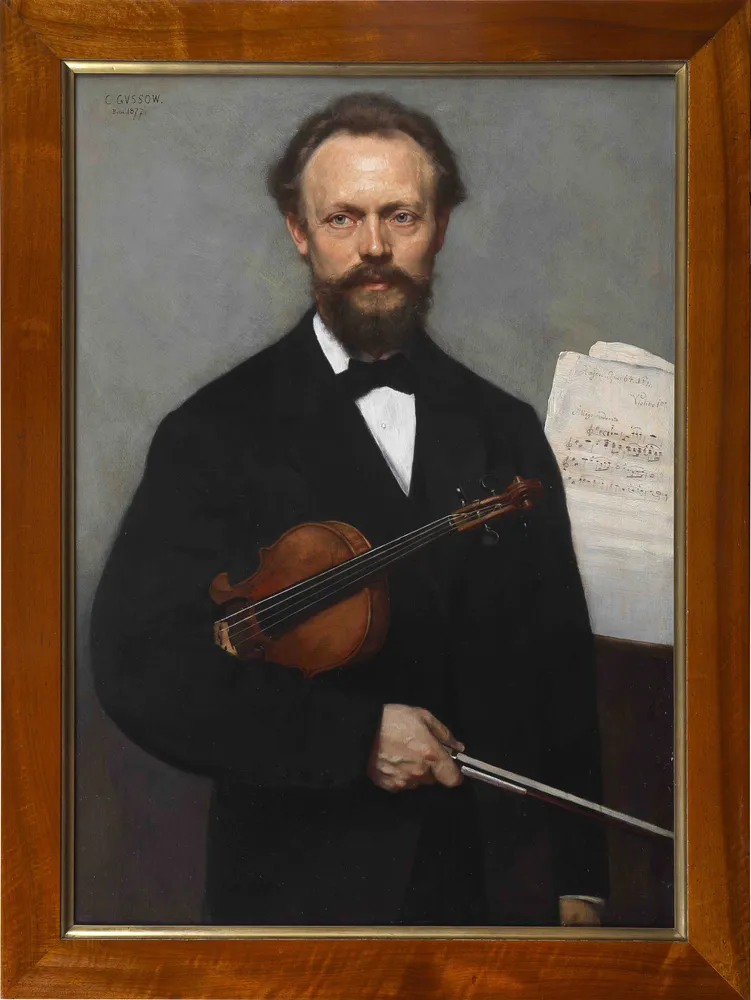
Carl GUSSOW , Portrait of a Violinist, 1877

Carl GUSSOW

Portrait of a Violinist, 1877
Oil on canvas
98 x 69 cm
Signed and dated upper left: C. Gussow. / Brln. 1877.
ENQUIRE
%3Cdiv%20class%3D%22artist%22%3ECarl%20GUSSOW%20%3C/div%3E%3Cdiv%20class%3D%22title_and_year%22%3E%3Cspan%20class%3D%22title_and_year_title%22%3EPortrait%20of%20a%20Violinist%3C/span%3E%2C%20%3Cspan%20class%3D%22title_and_year_year%22%3E1877%3C/span%3E%3C/div%3E%3Cdiv%20class%3D%22medium%22%3EOil%20on%20canvas%3C/div%3E%3Cdiv%20class%3D%22dimensions%22%3E98%20x%2069%20cm%3C/div%3E%3Cdiv%20class%3D%22signed_and_dated%22%3ESigned%20and%20dated%20upper%20left%3A%20C.%20Gussow.%20/%20Brln.%201877.%3C/div%3E
View on a wall
Read more
The present portrait, signed and dated 1877 with the explicit indication that it was executed in Berlin, belongs to the period of full maturity in the Berlin career of Carl Gussow, one of the most refined interpreters of German academic realism in the second half of the nineteenth century.
The painting depicts a violinist shown half-length and facing the viewer, dressed in a formal dark suit with a black bow tie. He holds the violin under his left arm while the bow is firmly grasped in his right hand. In the background, slightly set back, a musical score appears bearing the indication “Violine” and the reference to “Op. 64”, an element of crucial importance for the iconographic interpretation of the painting. The reference to Opus 64 most likely alludes to the celebrated Streichquartette (String Quartets) Op. 64 by Joseph Haydn, composed in 1790 and known as the “Tost-Quartette”[1]. These works formed one of the most frequently performed quartet cycles in the nineteenth-century repertoire and occupied a central position in the chamber music culture of Berlin in the second half of the century. The fact that the score is labeled “Violine” suggests that it represents the part for the first violin—the Erster Geiger—a key figure within the hierarchy of a chamber ensemble. This detail shifts the interpretation of the painting: rather than portraying a generic musician, it likely represents a first violinist, possibly a Konzertmeister or a highly accomplished performer active within the professional musical circles of the city.
 
In 1877, Berlin was one of the principal musical centers of Europe. Since 1869, the Hochschule für Musik (Conservatory of Music) had been directed by Joseph Joachim, a dominant figure in the German violin world and a promoter of a rigorous and classicist interpretative ideal deeply rooted in the repertory of Haydn and Beethoven[2]. The Joachim circle placed great emphasis on the string quartet tradition and on the leading role of the first violin as both the musical and moral guide of the ensemble. The reference to a Haydn score within the painting appears perfectly consistent with this cultural climate. Although no documents currently allow a secure identification of the sitter, the strongly individualized physiognomy—high forehead, penetrating light-colored eyes, and a full, carefully groomed beard—suggests a portrait painted from life rather than a generic type. The hypothesis of a connection with the circle of Joseph Joachim is therefore compelling, although a comparison with known photographic portraits of Joachim reveals certain differences[3].
Among musicians active in the Berlin musical environment of the period, the closest resemblance seems to emerge with Emanuel Wirth (1842–1923), the renowned violist of the Joachim Quartet and a professor at the Berlin Hochschule für Musik. The sitter’s physiognomy—particularly the high, receding forehead, the full beard, and the elongated facial structure—shows notable similarities with known photographs of Wirth (Fig. 1).
 
 Fig. 1 Emanuel Wirth (1842–1923)  photographed around 1895
 
This possible connection becomes even more suggestive when considering that the Joachim Quartet was among the foremost interpreters of the classical quartet repertoire, including the Haydn quartets to which the score depicted in the painting appears to allude[4].
 
From a stylistic point of view, the painting is fully consistent with Carl Gussow’s Berlin production of the 1870s. After his training in Berlin and Düsseldorf, the artist was appointed in 1874 as professor at the Königliche Akademie der Künste (Royal Academy of Arts) in Berlin, thereby consolidating his reputation as a highly regarded portrait painter[5]. His painting is distinguished by a meticulous rendering of surfaces, a firmly constructed drawing, and a restrained yet intense psychological introspection.
In the present work, the chromatic range is deliberately sober: a neutral grey-brown background, a compact dark suit, and the luminous emergence of the face and the violin, treated with a warm amber vibration. The light, grazing yet controlled, models the volumes without theatricality, in keeping with the austere aesthetic of Prussian academic realism. The violin is rendered with almost tactile attention: the varnish of the instrument reflects a warm light that contrasts with the severity of the attire, emphasizing the centrality of musical art in the life of the sitter. The bow, held in a resting position yet with professional naturalness, suggests a pause between performances rather than an artificial pose. The musical score—secondary in appearance but decisive in meaning—functions as an intellectual statement: Joseph Haydn as the paradigm of classical balance and formal discipline.
Works by Gussow are today preserved in several German public institutions, including the Nationalgalerie in Berlin and the Museum Kunstpalast in Düsseldorf, as well as in regional collections in northern Germany[6]. His presence in museum collections testifies to the recognition he received already during his lifetime and to the continued scholarly interest in his work. His paintings were regularly exhibited in Berlin’s academic exhibitions and in major German exhibitions of the period, consolidating a reputation that remained stable until his death in 1907.
Between 1875 and 1885, Gussow regularly participated in the Berlin academic exhibitions, presenting portraits that combined naturalistic precision with bourgeois dignity[7]. Although the specific exhibition of this particular painting has not yet been documented, its type and date correspond to the period of the artist’s greatest public visibility in the capital. The year 1877, in fact, represents a moment in which his mature artistic language had fully consolidated.
The present Portrait of a Violinist can therefore be placed within the dialogue between the visual arts and cultivated music in imperial Berlin, documenting an environment in which the figure of the professional musician—particularly that of the first violinist—embodied values of discipline, culture, and authority. The combination of psychological intensity, specific musical reference, and technical quality makes the painting a significant example of German portraiture of the late nineteenth century.


[1] Joseph Haydn, Streichquartette Op. 64 (1790), especially No. 5 in D major, known as the “Lerchenquartett,” among the most performed in the 19th century. See James Webster, “Haydn’s String Quartets Op. 64,” in The Cambridge Companion to Haydn, Cambridge 2005.

[2] Beatrix Borchard (ed.), Joseph Joachim. Biographie, Briefe und Dokumente, Kassel 2005.

[3] Comparison with photographs by Joseph Joachim preserved at the Staatsbibliothek zu Berlin, Musikabteilung; see also Andreas Moser, Joseph Joachim. Ein Lebensbild, Berlin 1908.

[4] Tully Potter, “The Joachim Quartet and Its Legacy”, in The Cambridge Companion to the String Quartet, Cambridge 2003.

[5] Allgemeines Künstlerlexikon, München–Leipzig, “Gussow, Carl”.

[6]Hans Vollmer (ed.), Allgemeines Lexikon der bildenden Künstler von der Antike bis zur Gegenwart, Leipzig 1907–1950, voce “Gussow”.

[7] Catalogs of the Königliche Akademie der Künste, Berlin, 1875–1880.

Previous
|
Next
83 
of  186

ROME 

VIA MARGUTTA  54, 00187

info@alfineart.com


Instagram, opens in a new tab.
Facebook, opens in a new tab.
Youtube, opens in a new tab.
Join the mailing list
View on Google Maps
Copyright ©2024AntonacciLapiccirellaFineArt
Site by Artlogic
Close

Join the mailing list

Subscribe to our newsletter to receive all the news about exhibitions, fairs and new acquisitions!