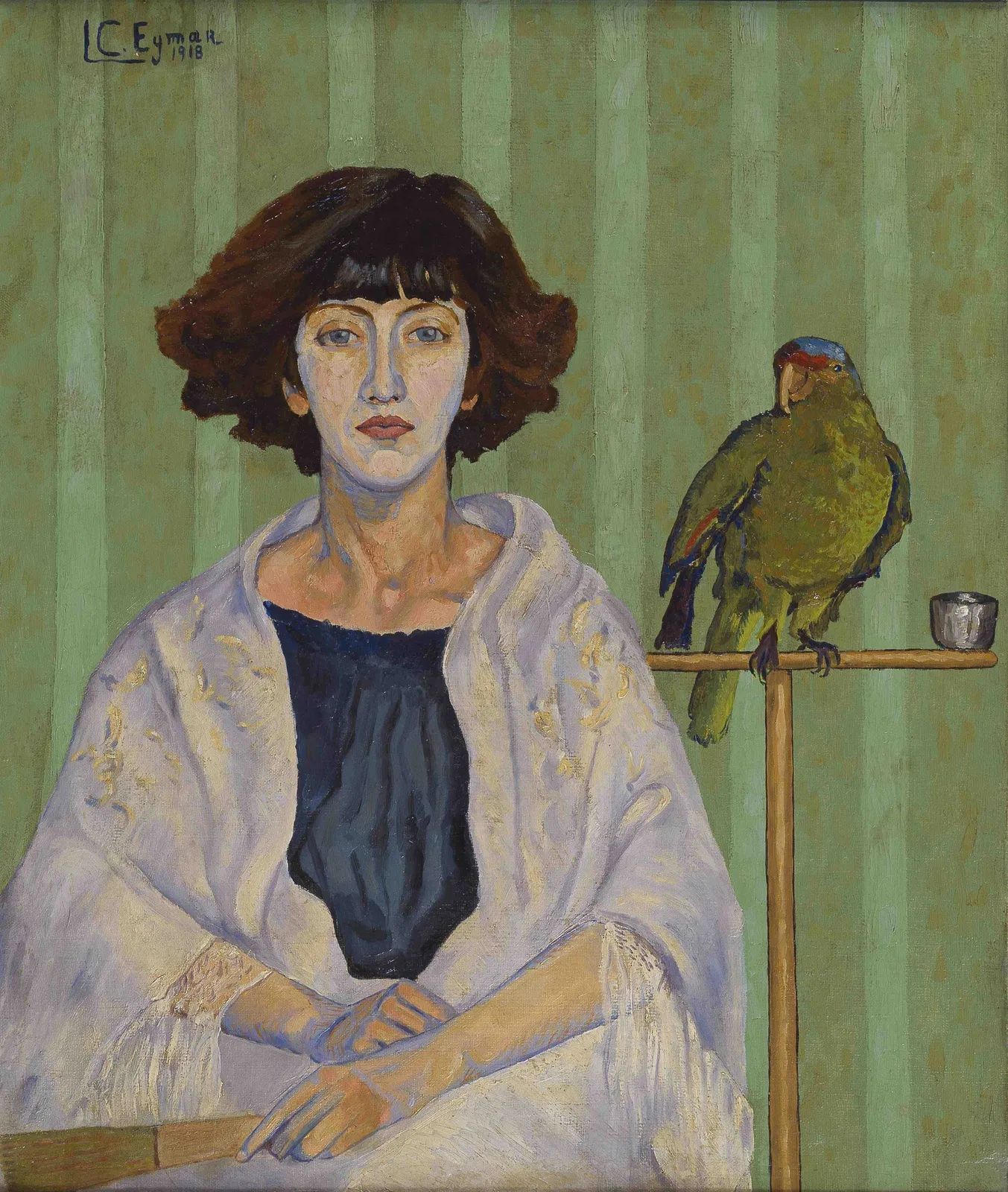
Louis Charles EYMAR
Woman with parrot, 1918
Oil on canvas
55 x 46 cm
Signed and dated top left: LC. Eymar 1918 - On the verso: label “Peut-être Madeleine Eymar (épouse du peintre)”
This portrait, painted in 1918, stands as one of the most refined achievements of Louis Charles Eymar,a discerning and original French painter. Though not widely known to the general public, Eymar fully belongs within the context of European portraiture in the years immediately following the First World War.
In his youth, he gravitated toward avant-garde literature through his friendship with Valéry Larbaud, yet he soon discovered his true vocation in color. After years of experimentation with pictorial matter, he developed a technical mastery that placed him on a level comparable with the great draughtsmen. One critic described him as a “singular stylist, certainly close to Henri de Toulouse-Lautrec in his choice of subjects and to Raoul Dufy in his stenographic ability to capture the essential detail.”
The quality of his graphic work is attested by the presence of numerous drawings and watercolors preserved in Montpellier at the Fabre Museum and in Paris at the Centre Pompidou, including Femme en bleu, Femme en rose, Femme à sa toilette, and Deux femmes à la campagne, executed in various techniques on paper (graphite and watercolor).
The painting portrays a young woman of hieratic bearing, his wife Madeleine, wrapped in a light embroidered shawl that contrasts with the vertically striped background. The frontal composition, close cropping, and steady gaze recall the lesson of Félix Vallotton and, more broadly, the synthetic portraiture of the Nabis school, in which the psychology of the sitter is conveyed through formal tension and the disciplined control of chromatic masses. Like Vallotton, Eymar privileges linear clarity, a frontal structure, and a carefully calibrated palette, translating the subject’s inner complexity into essential and controlled forms.
The striped background is particularly significant, echoing a motif typical of Vallotton’s bourgeois interiors and portraits. Here, the stripes are not merely decorative; rather, they intensify the stillness of the figure and heighten the sense of suspension, creating a silent dialogue with the French post-Impressionist tradition.
The rendering of the face, defined by firm draftsmanship and restrained modeling, recalls the Italian early Renaissance tradition, from Piero della Francesca to Domenico Ghirlandaio, aligning the work with the broader European climate of the “return to order” that characterized the difficult years following the Great War. In certain respects, the painting also recalls works by Felice Casorati, sharing with him a pictorial language grounded in frontal composition and the immobility of figures—elements that lend both artists’ works a hieratic and suspended aura.
On the reverse of the stretcher appears an oval stamp featuring an anchor and a caduceus, the historic trademark of Lefranc Bourgeois (adopted in 1880), attesting to the use of professional French materials of the period.
13
of
13