Antonacci Lapiccirella Fine Art
Skip to main content
  • Menu
  • About us
  • Exhibitions
  • Collection
  • Publications
  • News
  • Notable Sales
  • Services
  • Contact
  • EN
  • IT
Menu
  • EN
  • IT
Collection

WORKS ON PAPER

Guido MARUSSIG, L’albero morto e l’edera [The Dead Tree and Ivy] 1917

Guido MARUSSIG

L’albero morto e l’edera [The Dead Tree and Ivy], 1917
Mixed media on cardboard
53 x 43 cm
Signed lower right: GVIDO MARVSSIG • On the verso: Guido Marussig / “L’albero morto e l’edera”
ENQUIRE
%3Cdiv%20class%3D%22artist%22%3EGuido%20MARUSSIG%3C/div%3E%3Cdiv%20class%3D%22title_and_year%22%3E%3Cspan%20class%3D%22title_and_year_title%22%3EL%E2%80%99albero%20morto%20e%20l%E2%80%99edera%20%5BThe%20Dead%20Tree%20and%20Ivy%5D%3C/span%3E%2C%20%3Cspan%20class%3D%22title_and_year_year%22%3E1917%3C/span%3E%3C/div%3E%3Cdiv%20class%3D%22medium%22%3EMixed%20media%20on%20cardboard%3C/div%3E%3Cdiv%20class%3D%22dimensions%22%3E53%20x%2043%20cm%3C/div%3E%3Cdiv%20class%3D%22signed_and_dated%22%3ESigned%20lower%20right%3A%20GVIDO%20MARVSSIG%20%20%E2%80%A2%20On%20the%20verso%3A%20Guido%20Marussig%20/%20%E2%80%9CL%E2%80%99albero%20morto%20e%20l%E2%80%99edera%E2%80%9D%3C/div%3E
Read more

Exhibitions

1917, Milan, Galleria Pesaro; 1920, Milan, Galleria Pesaro.

Literature

M. Sarfatti, Le Tre Venezie (Milano, Galleria Pesaro), in “Pagine d'arte”, V (1917), no. 4, pp. 86-88;

V. Pica, Mostre individuali, V. Zanetti-Zilla, G. Marussig, B. Disertori, V. Zecchin, exhibition catalogue, Galleria Pesaro, Milan 1920, p. 13, no. 41;

V. Strukelj, Guido Marussig nel segno della grafica: un percorso tra opere e critica, in V. Strukelj, G. Sgubbi, edited by, Guido Marussig. Il mestiere delle arti, exhibition catalogue, Trieste 2004, p. 18.


Reference bibliography:

E. Prete, s.v. Guido Marussig, in La pittura nel Veneto. Il Novecento. Dizionario degli artisti, edited by N. Stringa, Milano 2009, p. 278.

Like Ferruccio Scattola (Venice 1873 – Roma, 1950) and, even more avowedly, Teodoro Wolf Ferrari, (Venice, 1878 – San Zenone degli Ezzelini, 1945), Guido Marussig also moved at ease between the Biennale, where he made his debut at the age of twenty, in 1906, and Ca' Pesaro, where he exhibited as early as 1908, even graphically designing its first manifesto.
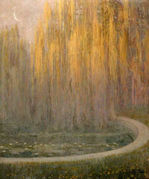
He trained in a Mitteleuropean climate, between Trieste and Venice, where he attended the Accademia with Ettore Tito and Augusto Sezanne. His poetics was already well defined by 1907, when he was invited to exhibit Weeping Willow in the Biennale hall, dedicated to the Art of the Dream. This work, much appreciated by his contemporaries, was recently re-proposed to the public on the occasion of the exhibition dedicated to Klimt and Italian Art at the Mart in Rovereto (fig. 1).
In the wake of Mario de Maria (Bologna, 1852 - 1924) and parallel to Gennaro Favai (Venezia, 1879 – 1958), Marussig assimilated the culture of German Symbolism, softened in a decorative key. He is distinguished by compositions of exquisite execution, devoid of human figures, built on a close-up viewpoint and characterised by an extremely modern cut. His landscapes, very selected (and very rare), re-propose the chromatic cascades of Klimt's secessionism (fig. 2), to which is mixed with highly original formula certain Nabis synthetism, borrow from the painter's proximity to the Ca' Pesaro group, to Gino Rossi (Venice, 1884 – Treviso, 1947) and Umberto Moggioli (Trento, 1886 – Rome, 1919) in particular.
 
The Venetian season ended with the first maturity of the artist. He moved to Milan in 1916, successfully inserted himself into the reality of the city by taking part in some important exhibitions. In particular, in April 1917, he presented L'albero morto e l'edera (The Dead Tree and Ivy), to be identified in all likelihood with the work under consideration, at the Galleria Pesaro as part of the Tre Venezie exhibition. The syntheticism of Secessionist taste, mindful of the Capesarina season, is declined here in the terms of a highly refined decorativism, which did not escape the attentive eye of Margherita Sarfatti, who made express mention of it in her article in the “Pagine d'arte” (1917)
 
After his experience in Fiume alongside Gabriele D'Annunzio (who commissioned him to decorate the Vittoriale), Marussig was engaged in painting as well as in the decorative arts and architecture, areas in which he was fully involved in the climate of the Italian Novecento.
 
Fig. 1 - Salice piangente (Weeping Willow), 1907 (private collection)
 
Fig. 2. - Laghetto dei salici (Willows pond), 1909, Trieste, Museo Revoltella
 
Previous
|
Next
8 
of  30
You may also like
  • MARUSSIG, Guido Alba di luna su l'Estuario [Moonrise on the Estuary] 1920
    Guido MARUSSIG
    Alba di luna su l'Estuario [Moonrise on the Estuary], 1920
  • Angelo DALL'OCA BIANCA, Self-portrait, 1914 Mixed media on cardboard
    Angelo DALL'OCA BIANCA
    Self-portrait, 1914
  • Snowy Landscape in Moonlight
    Oskar BERGMAN
    Snowy Landscape in Moonlight, 1912
  • HILDING WERNER, Snowy landscape, 1910 c. • Antonacci Lapiccirella Fine Art, Roma
    HILDING WERNER
    Snowy landscape, 1910 c.
  • Jean-Achille BENOUVILLE, View of Villa Medici, 1864 - Antonacci lapiccirella Fine Art, Roma
    Jean-Achille BENOUVILLE
    View of Villa Medici, 1864
  • View from the Villa Borghese in Rome
    JAKOB PHILIPP HACKERT
    View from the Villa Borghese in Rome, 1781
  • Alessandro POMA, Autunm (Villa Borghese), c. 1919 - 1920, Pastel on paper
    ALESSANDRO POMA
    Autumn, c. 1919 - 20
  • Piero Persicalli, Gaze into the abyss
    Pietro PERSICALLI
    Gaze into the abyss, c. 1913 - 15

ROME 

VIA MARGUTTA  54, 00187

info@alfineart.com


Instagram, opens in a new tab.
Facebook, opens in a new tab.
Youtube, opens in a new tab.
Join the mailing list
View on Google Maps
Manage cookies
Copyright ©2026AntonacciLapiccirellaFineArt
Site by Artlogic

This website uses cookies
This site uses cookies to help make it more useful to you. Please contact us to find out more about our Cookie Policy.

Manage cookies
Reject non essential
Accept

Cookie preferences

Check the boxes for the cookie categories you allow our site to use

Cookie options
Required for the website to function and cannot be disabled.
Improve your experience on the website by storing choices you make about how it should function.
Allow us to collect anonymous usage data in order to improve the experience on our website.
Allow us to identify our visitors so that we can offer personalised, targeted marketing.
Save preferences
Close

Join the mailing list

Subscribe to our newsletter to receive all the news about exhibitions, fairs and new acquisitions!