-
Artworks
Vito TIMMEL
Amazon , 1915Tempera on canvas91 x 71 cm
98 x 88 cm (with the frame)
Signed and dated lower left: Timmel / 1915Provenance
Private collection, Guayaquil, Ecuador; Private collection.
Exhibitions
Quadriennale Esposizione Nazionale di Belle Arti, Castello del Valentino, Turin, 1923, sala XIII, n. 657; Mostra personale, Trieste, Galleria Michelazzi, 1937; Vito Timmel 1886-1949, Trieste, Sala d’Arte di Palazzo Costanzi, July-Aug 1978.
Literature
La Quadriennale. Catalogo, Società Promotrice delle Belle Arti, Castello del Valentino, Turin 1923; pag. 58, n. 657; “Il Piccolo”, quotidiano di Trieste, 21.5.1937; Vito Timmel 1886-1949, exhibition catalogue at Sala d’Arte di Palazzo Costanzi, Trieste, 1978; Franca Marri, Vito Timmel, Nuova Collana d’Arte della Fondazione CR Trieste, 2005, p. 41, fig. 32, cat. 28.
An elegant representative of the Vienna Secession, Vito Timmel was an imaginative and highly changeable artist. He painted Post-Impressionist portraits and landscapes marked by intense colors and striking light effects, moving with ease between a naïve style and a Secessionist approach. Timmel was greatly appreciated by critics of his time. The originality of his line, his Nordic sensibility, and the expressive strength of his style are closely linked to his Viennese training, his involvement in Secessionist circles, and his fellow students at the Academy of Fine Arts in Vienna, including Richard Gerstl, Oskar Kokoschka, and Egon Schiele. Above all, they reflect the influence of his greatly admired teacher, Gustav Klimt.
Like Klimt, Timmel was able to blend diverse and seemingly contrasting inspirations, ranging from Byzantine art to Japanese art and Oriental decorative traditions in general. At the same time, he maintained a strong classical compositional structure, enriched by literary, mythological, and musical influences.Around 1915, the first amazons began to appear in Timmel’s paintings and graphic works: female figures wearing wide-brimmed hats, as well as elegant ladies accompanied by dogs. These subjects captivate the viewer through their rich decorative settings, intentionally bold, provocative, and seductive poses, and the fashionable clothing they wear. In particular, the black-and-white striped dresses once again recall Vienna, the Jugendstil movement, and the “artistic dresses” designed by Koloman Moser and Gustav Klimt.
Amazzone, 1916«Tra queste, particolarmente significativa risulta essere un’Amazzone (1915) dai capelli rossi, colta di schiena, in un abito nero dai riflessi blu, rossi e bruni che le lascia scoperte le spalle: l’opera verrà esposta e riprodotta in catalogo alla Quadriennale di Torino del 1923. La stessa affascinante figura femminile dai capelli rossi, col medesimo abito nero cangiante ricompare in un dipinto successivo (1916), questa volta in una posa frontale, leggermente di tre quarti, che rivela l’audace décolleté. I motivi geometrici e floreali di chiara derivazione Jugendstil fanno da contrappunto al colore e alle ampie pieghe del vestito.» [1]«Among these works, a particularly significant example is an amazon (1915) with red hair, depicted from behind, wearing a black dress with blue, red, and brown reflections that leaves her shoulders bare. The painting was later exhibited and reproduced in the catalogue of the Quadriennale di Torino. The same captivating red-haired female figure, dressed in the same iridescent black gown, reappears in a later painting (1916). This time she is shown in a frontal pose, slightly turned three-quarters, revealing a daring décolleté. The geometric and floral motifs clearly inspired by Jugendstil create a refined counterpoint to the color and the broad folds of the dress. »[1] Franca Marri, Vito Timmel, Nuova Collana d’Arte della Fondazione CR Trieste, 2005, pag. 43
You may also like-
Henriette DAUXSelf-Portrait of the Artist at the Easel, 1880 – 85 c. -
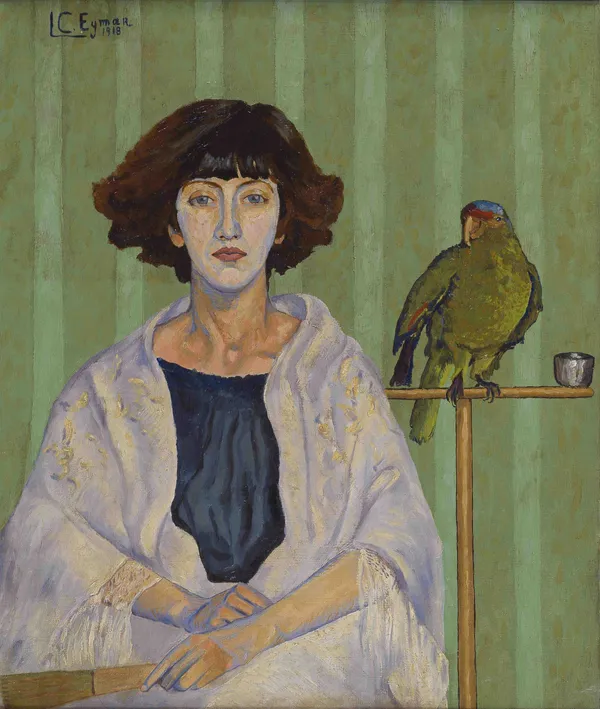
Louis Charles EYMARWoman with parrot, 1918 -
Giovanni Battista CostantiniIl dominio [Dominion], 1915 -
Philip Alexius de LÁSZLÓPortrait of the singer Germaine Gien, 1921 -
ARTURO CASTELLIJaguars, 1918 -
Pietro PERSICALLIWoman with black cup, 1910 c. -
Pietro PERSICALLIGaze into the abyss, c. 1913 - 15 -
EDITA BROGLIOThe four hours of the Day: Dawn, Noon, Dusk, Night, 1956 -
REMIGIO ANNOVATIThe Pearl, c. 1934 -
Attilio SelvaRitmi, 1914
-
Join the mailing list
Subscribe to our newsletter to receive all the news about exhibitions, fairs and new acquisitions!